People’s Compute / Las Vegas GPU Pilot 1
We convert underused warehouse space into a micro data center. We install a server with 8 NVIDIA GPUs and rent its capacity to AI developers. Investors receive quarterly cash distributions. Like real estate, it’s a physical asset that produces income, with a higher projected return, and the hardware can be sold far faster than a building.
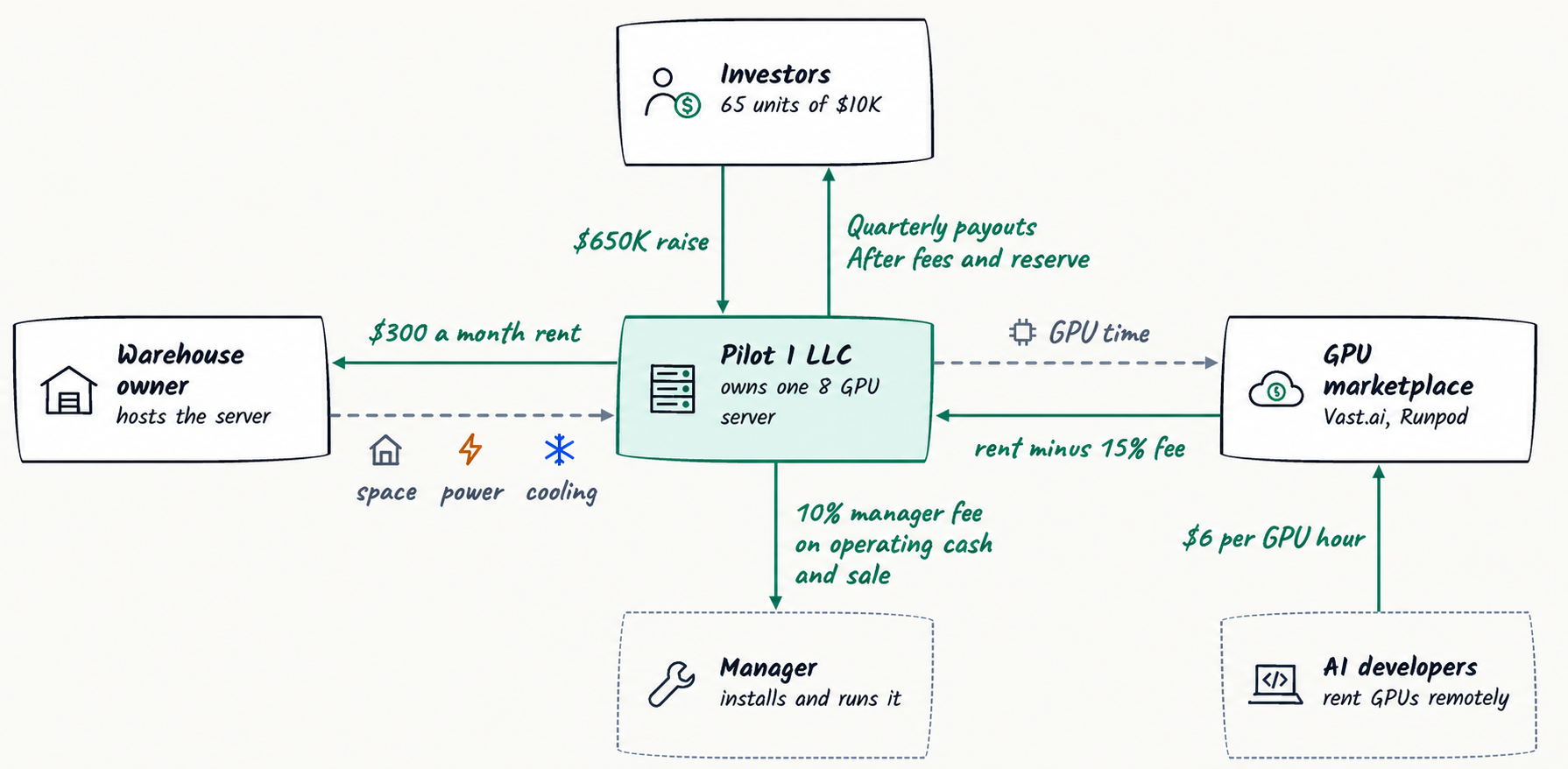 Expand diagram
Investors buy units in Las Vegas GPU Pilot 1, LLC, a Nevada LLC that owns this one server and nothing else.
The LLC buys the server and installs it at 6000 S Eastern Ave with its own power circuit, cooling and fiber line.
AI developers rent GPU capacity by the hour. The base case assumes a 15% blended effective marketplace commission fee.
Net cash is paid out each quarter, starting March 31, 2027.
Big projects stall on permits and power; small ones earn sooner.
Big data center deals take millions, shutting most investors out.
Runs on the building’s existing grid connection.
Warehouse owners earn rent from unused space.
Air cooling keeps local water use at zero.
The LLC owns one eight-GPU server and related assets. Investors can approve an earlier sale if market prices fall; the operating agreement also requires a sale if GPU rental income stays below operating expenses for 12 consecutive months.
Each site is planned as its own LLC with its own server, bank account and investors, so one location is not required to fund another location’s operating loss.

Big data centers are stalling. Small ones aren’t.
In several major markets, large data centers can wait 4 to 7 years for grid power. Our target is to bring a small site online and earning in weeks.
JLL 2026 data center outlookLocal opposition blocked or delayed projects worth about $130 billion in Q1 and $68 billion in Q2 2026: nearly $200 billion in the first half.
Data Center Watch Q1 · Q285% of listed B200 GPUs were marked rented in our November 7 snapshot.
View the dated listing snapshotIn Q3 2026, 6.4% of U.S. industrial space sat vacant. We turn unused warehouse space into rent for local owners, so communities share the upside.
CBRE Q3 2026 U.S. industrial report| Server | $499,000 |
| Sales tax, 8.375% | $41,791 |
| Power circuit, cooling, rack and network | $35,000 |
| LLC formation and legal documents | $15,000 |
| Cash reserve | $59,209 |
| Total raise | $650,000 |
A $50,000 minimum reserve rounds funding to 65 units of $10,000, leaving $59,209 in reserve. The model assumes 3.32% annualized net yield on a government money market fund, credits income monthly, and replenishes the reserve before investor payouts. Reserve assumptions
| Renters pay49,932 paid GPU-hours × $6.00 | $299,592 |
| Marketplace commission fee15% of rent | -$44,939 |
| Electricity124,918 kWh × $0.08, cooling included: 34% of operating costs | -$9,993 |
| Insurance premium$250 a month for equipment and liability coverage | -$3,000 |
| Other operating costs and siteInternet, accounting, repairs and $300 a month for space | -$16,800 |
| Management fee10% of positive operating cash | -$22,486 |
| Net operating cash | $202,374 |
| Reserve investment income3.32% annualized net-yield assumption | $1,942 |
| Cash to investors | $204,316 |
Every operating cost, by item and year
Per $100,000 invested: $31,433 in year 1.
-11.6%
annualized IRR
20% launch-quarter and 50% ongoing utilization; rates fall 20% a year; 25% commission fee; 10% residual value.
24.7%
annualized IRR
30% launch-quarter and 85% ongoing utilization; rates fall 10% a year; 15% commission fee; 30% residual value.
46.1%
annualized IRR
60% launch-quarter and 95% ongoing utilization; rates fall 5% a year; 3% processing cost; 40% residual value.
The base case includes a 30% launch-quarter utilization assumption, 85% thereafter, a 10% annual rental-rate decline, 3% annual cost inflation and a repairs budget. The downside scenario tests lower utilization, faster rate declines and higher marketplace charges. Extended outages and a total equipment loss are separate risks the model does not quantify.
Contact michael@computepeople.com with the number of units you want.
Complete the subscription agreement and accreditation check. December 4, 2026 is the initial target.
Wire to the LLC account after the full raise is confirmed. December 11, 2026 is the initial target.
The model assumes rental revenue starts January 1, 2027 and distributions begin March 31, 2027. A later closing moves those dates.
The raise is all-or-nothing. If the full $650,000 is not raised within six months after the offering opens, the project is canceled and each investor receives back exactly the amount they contributed, with no fee or deduction. No investor funds are deployed before the full raise. A later closing moves the installation and distribution schedule.
Under the modeled equipment policy, water damage to the server is covered. The insurer pays covered repair or replacement costs up to the policy limit, less the deductible. The LLC bears the deductible, any loss above the limit, and rental income lost while the server is down.
If the equipment policy covers theft, the manager would file a claim. Insurance proceeds belong to the LLC. The LLC bears any deductible, excluded loss and rental downtime; investors bear the resulting reduction in proceeds.
The base case includes a $250 monthly premium for replacement-cost equipment coverage and general liability insurance. For these FAQs, water damage to the server is assumed covered. The simulator lets you change the premium. The insurer, deductible, policy limit and theft terms are not specified in the model.
No. The model does not include business-interruption coverage or an insurance recovery. A covered equipment claim could pay for hardware, while rental revenue lost during an outage would still reduce cash distributions.
Yes. Investors holding a majority of units may approve an early sale. The operating agreement also requires a sale after 12 consecutive months when rent after marketplace charges does not cover running costs. There is no fixed percentage price-drop trigger in the current agreement.